Bushcraft at the Lake 10/17-18/2026
Master the Wild: Wilderness Survival & Bushcraft
When you step into the backcountry, you leave behind the safety nets of modern infrastructure. Without practical skills, you become dependent on your equipment and vulnerable to the environment.
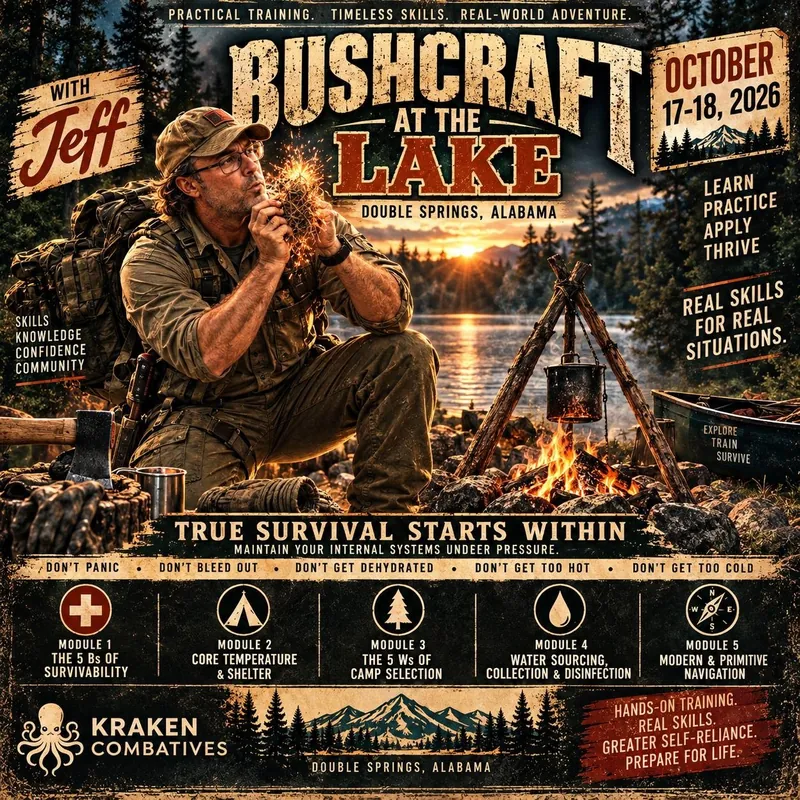
Led by survival instructor Jeff Thornton, Master the Wild combines wilderness survival, bushcraft, self-aid, and environmental awareness into a practical framework for becoming more capable and self-reliant in the outdoors.
The course focuses on one fundamental principle:
Skills over gear.
Knowledge weighs nothing, takes up no space, and can turn limited resources into lifesaving solutions.
Core Lessons
1. Survival Mindset: STOP & Situational Awareness
Your most important survival tool is your mind. Students learn the STOP protocol—Stop, Think, Observe, and Plan—to manage stress, avoid impulsive decisions, assess actual threats, and develop a deliberate course of action.
The course also emphasizes silent awareness, energy conservation, environmental observation, and adaptive movement.
2. Core Temperature Management
Maintaining core body temperature is a critical survival priority. Students learn how exposure, wind, moisture, and ground contact contribute to heat loss and how to reduce those risks.
Through shelter selection and construction, students explore the principle of having “something to sleep on, in, and under” to protect against conductive and convective heat loss.
3. The 5 Cs of Survival
Students learn how a small number of versatile tools and materials can address multiple survival problems:
- Cutting: Knives, saws, and other cutting tools
- Cover: Shelters, ridgelines, and ground insulation
- Combustion: Fire for warmth, cooking, water treatment, and signaling
- Containers: Collecting, transporting, and treating water
- Cordage: Paracord, bankline, and natural materials
The course also introduces additional sustainability tools and materials that help maintain equipment, navigate, repair gear, and extend field capability.
4. Firecraft & Primitive Skills
Fire is one of the most important survival resources. Students learn the fundamentals of fire construction, fuel selection, heat management, and signaling.
Primitive fire-making techniques—including the bow drill, hand drill, and fire plough—demonstrate how to create fire when modern ignition sources are unavailable.
5. Water Procurement & Treatment
Access to safe water is essential. Students learn how to locate, collect, filter, and disinfect water using practical field methods.
Instruction covers turbidity reduction, filtration, and treatment through boiling, chemical disinfection, and other physical methods, helping students understand both the capabilities and limitations of different approaches.
6. Self-Aid & Survivability
Students learn foundational self-aid principles for managing injuries and environmental emergencies when professional medical assistance may be delayed.
The course emphasizes recognizing problems early, protecting the body from further injury, conserving resources, and making sound decisions while awaiting rescue or self-evacuating.
7. Navigation & Environmental Adaptation
Students develop practical skills for reading and understanding their environment, using navigation tools, identifying terrain features, and making informed movement decisions.
The goal is not simply to “survive” the wilderness, but to understand it well enough to move through it responsibly and effectively.
The Goal: Capability & Self-Reliance
Master the Wild is designed to move students from gear dependence toward practical self-reliance.
By combining mindset, bushcraft, survival skills, self-aid, navigation, and environmental awareness, students gain the knowledge and confidence to respond effectively when plans change, equipment fails, or modern conveniences are no longer available.
Prepare. Protect. Pass It On.
Instructors
Chris Magyar
Jay Martin
Jeff Thornton
Contact us
- Chris Magyar
- ch••••r@myf••••e.com
- 2052020325
Location
Classifications
Age Groups
- Adult
Levels
- All